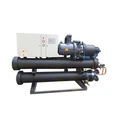
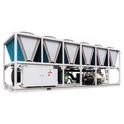
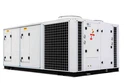
1.Basic Working Principle
Refrigeration cycle process
1) Compression: Ammonia gas is pressurized by a compressor into high-temperature and high-pressure gas (such as 25bar, 80℃).
2) Condensation: High-temperature ammonia gas is cooled in a condenser through water or air, liquefying and releasing heat.
3) Throttling: Liquid ammonia is depressurized through an expansion valve, and its temperature drops sharply to the evaporation temperature (such as -30℃).
4) Evaporation: Low-temperature liquid ammonia absorbs heat and vaporizes in the evaporator, achieving refrigeration.
5) COP: The COP of the ammonia system is usually 3.5 to 6.0, which is much higher than that of Freon (R22 COP≈3.0).
2. Core Components
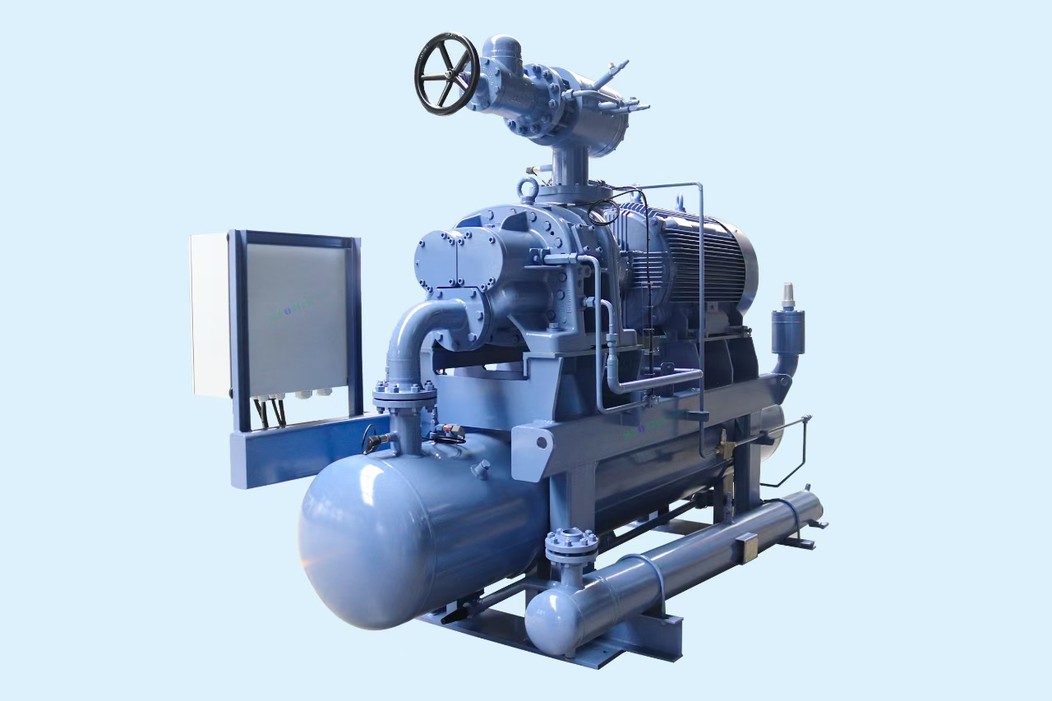
1) Ammonia compressor: It provides power and is divided into piston type, screw type and centrifugal type
2) Evaporative condenser: The heat exchange core is mostly shell and tube type or plate type
3) Reservoir: Store liquid ammonia and balance the system load
4) Safety control system: Monitor the ammonia concentration, pressure and temperature to trigger an emergency shutdown
3. Core Advantage
1) Eco-friendly: The ODP of ammonia is 0 (does not damage the ozone layer), and the GWP is 0 (has no greenhouse effect), which is in line with the Montreal Protocol.
2) Economical efficiency: The cost of ammonia is only 1/5 of that of Freon, and its operating energy consumption is low (saving over 30% of electricity).
3) High-efficiency refrigeration: It has a large latent heat of evaporation (1370 kJ/kg, which is five times that of R22) and is suitable for a wide temperature range of -50℃ to 10℃.
4. Application
1) Food freezing: Quick-freezing warehouse (-35℃), cold chain (such as tuna processing).
2) Chemical refrigeration: Cooling of ammonia synthesis plants and petrochemical reaction vessels.
3) Cold chain logistics: Large cold storage facilities (such as JD Asia No.1 Warehouse).
5. Safety and Regulatory Requirements
1) Security risk: Ammonia is toxic (IDLH=300ppm) and flammable (explosion limit 15% - 28%), and strict protection is required.
2) Design standard
International: ISO 5149, IIAR (International Institute for Ammonia Refrigeration) standards.
China: GB 50072-2021 "Code for Design of Cold Storage" mandatorily requires leakage monitoring and explosion-proof design.
3) Emergency Measure
To install ammonia gas sensors and sprinkler systems, the operators must hold relevant certificates (such as pressure vessel operation certificates).
6. Comparison with the Freon system
Ammonia System Freon System (R404A)
Refrigerating efficiency High (COP≥4.0) Medium (COP≈3.0)
Eco-friendly Excellent (ODP=0, GWP=0) Poor (GWP=3922)
Safety Strict management is required Relatively safe (Class A1)
Initial outlay Higher (about 30% more) Lower