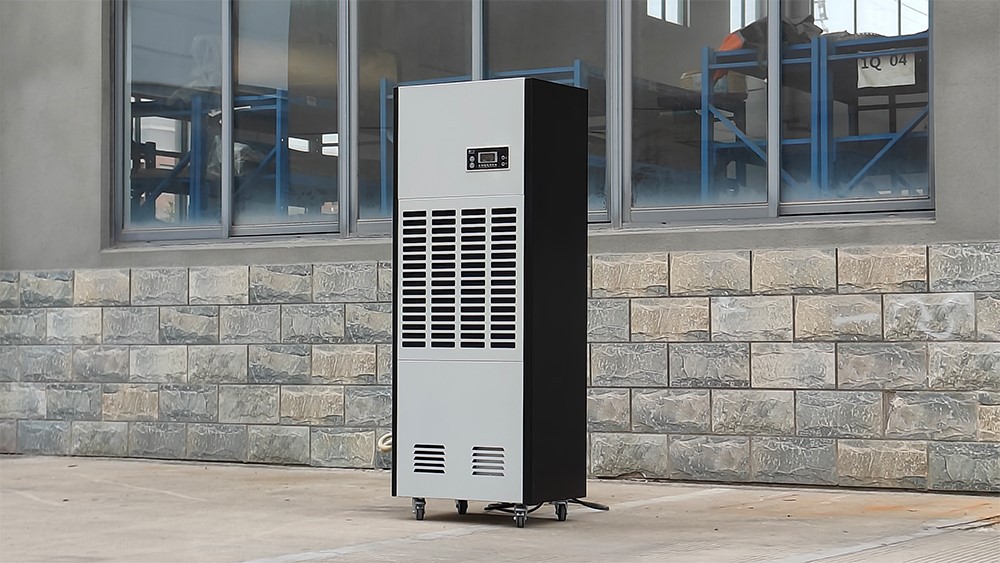
There is a clothing warehouse with an area of 6,000 square meters and a height of 19.8 meters. The current indoor humidity range is 60% to 84%, and it is equipped with exhaust fans and shutters. It is required to reduce the humidity to below 60% within one hour. How should a dehumidifier with a dehumidification capacity of 168 liters per day be configured and installed?
A. Basic Data
Warehouse volume = 6,000 square meters × 19.8 meters = 118,800 cubic meters
Current humidity range = 60% to 84% (calculated based on the worst case of 84%)
Target humidity = below 60%
Dehumidifier model: 168 liters per day = 7 liters per hour
B. Estimate the required dehumidification capacity
Let's calculate based on the reduction of water vapor content:
1) Convert water volume based on humidity changes
Estimate using the table lookup method or simplified formula
At 25℃:
Relative humidity 84% ≈ 18.5 grams per cubic meter
Relative humidity 60% ≈ 13.2 grams per cubic meter
The amount of water vapor to be removed per cubic meter: 18.5-13.2 = 5.3 grams per cubic meter
2) The total amount of dehumidification water required: 118,800m³×5.3g/m³=629,640g≈630kg=630Liters
3) The dehumidification capacity of each dehumidifier (1 hour): Each unit has a dehumidification capacity of 7 liters per hour
4) The number of dehumidifiers required: 630÷7=90 units
C. Configuration recommendations
1) Number of dehumidifiers: Approximately 90 units (168L/ day model)
2) Way to install: Use floor-standing air conditioners or ceiling suspended dehumidifiers, and focus on covering areas with dense shelves and corners with poor air circulation
3) Air inlet layout: The air intake of the dehumidifier should be kept away from strong air sources (such as louvers and exhaust fans) to prevent the repeated entry of outdoor moist air
4) Air outlet layout: Point to the middle and upper floors, and work in conjunction with fans/air ducts to blow towards the upper air layer (with a focus on the 20-meter height zone)
5) Supplementary Measure: Close or partially close the blinds to reduce the inflow of external moisture. When necessary, use a high-power fan to drive air circulation and accelerate uniform dehumidification
6) Sealing: If the structure permits, it is recommended to close some of the natural ventilation openings to maintain a relatively sealed environment and improve the dehumidification efficiency
D. Suggestion on Optimization
1) If it is inconvenient to deploy 90 units, industrial dehumidifiers with a larger dehumidification capacity (such as 240L/ day or 480L/ day levels) can be selected to reduce the number of devices.
2) If dehumidification cannot be completed in a short time, it is advisable to appropriately extend the dehumidification time to 2 to 3 hours, thereby reducing equipment investment.
3) Dehumidification systems with supply air ducts (such as suspended/vertical industrial duct dehumidifiers) can be introduced to increase the coverage height.