The Working Principle Of An Air Handling Unit (AHU)
An Air Handling Unit (AHU) Is A Central Component Of HVAC (Heating, Ventilation, And Air Conditioning) Systems. Its Main Purpose Is To Condition And Circulate Air To Provide A Comfortable, Healthy, And Energy-Efficient Indoor Environment.
1. Air Intake
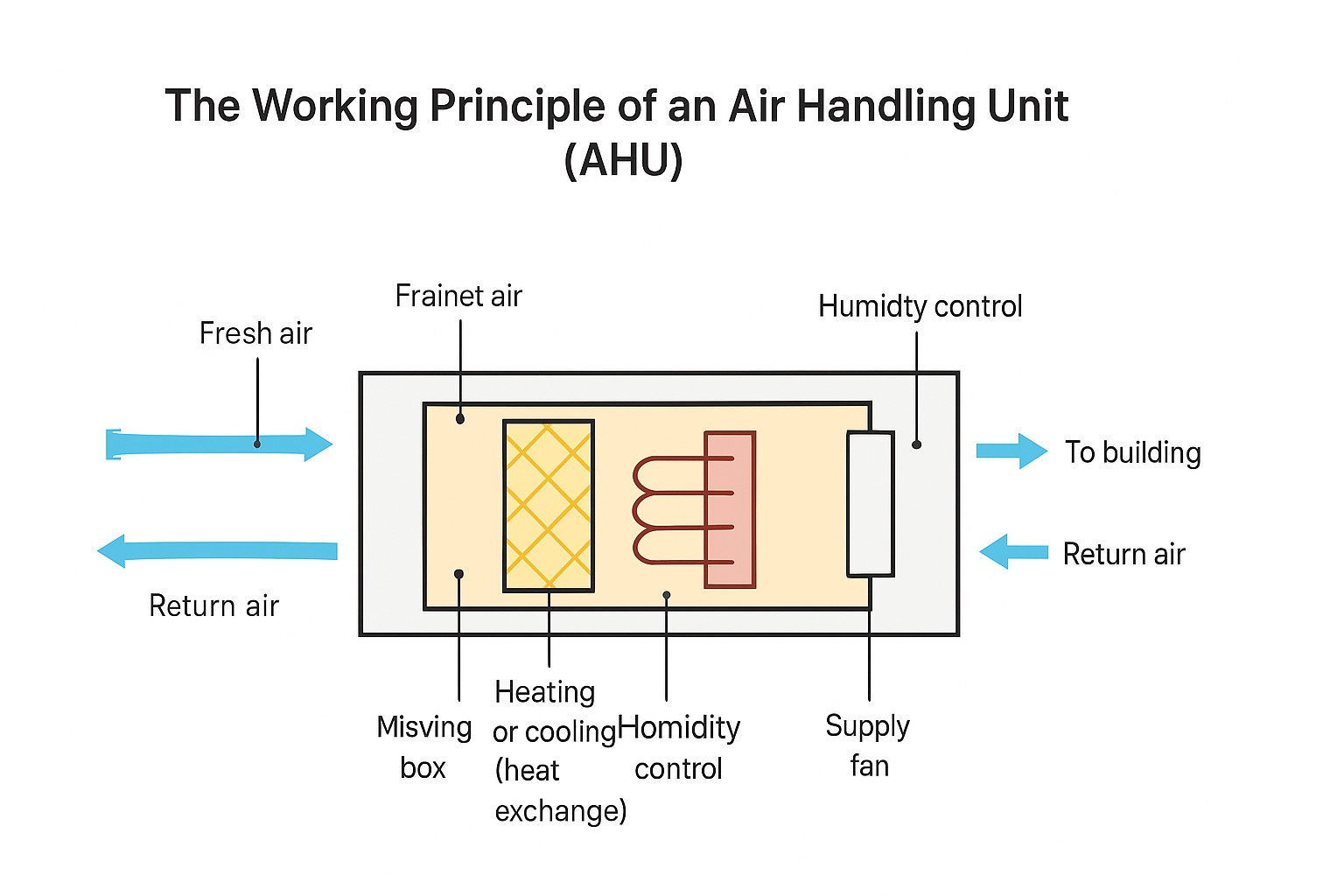
Fresh Air from outside and Return Air from the building are drawn into the AHU.
The mixing box combines them in a controlled ratio to maintain indoor air quality and energy efficiency.
2. Filtration
The mixed air passes through Air Filters that remove dust, pollen, and other airborne particles.
Different levels of filtration (coarse, fine, HEPA) can be applied depending on the building's requirements.
3. Heating Or Cooling (Heat Exchange)
The filtered air then moves across Heating Coils (hot water, steam, or electric) or Cooling Coils (chilled water or direct expansion refrigerant).
Here, the air is Heated In Winter or Cooled In Summer to reach the desired supply air temperature.
4. Humidity Control
To maintain indoor comfort, AHUs can include:
Humidifiers (to add moisture)
Dehumidification (through cooling coils that condense excess moisture)
This ensures proper Indoor Humidity Levels (typically 40–60%).
5. Air Distribution
After conditioning, the air is pushed by a Supply Fan into the ductwork.
The duct system distributes the conditioned air throughout the building spaces.
6. Return And Exhaust
Return Air from occupied spaces flows back to the AHU.
A portion of this air is Exhausted Outside to remove contaminants, while the rest is recirculated and mixed with fresh outdoor air.
Summary
In simple terms:
An AHU Takes In Outside And Return Air → Filters It → Heats/Cools It → Controls Humidity → Delivers It Into The Building → And Recycles Part Of It Back.
This continuous cycle ensures proper Ventilation, Temperature, And Humidity Control for occupant comfort and energy efficiency.