Dehumidification plays a crucial role in both daily life and production environments. Particularly in industrial settings, the control and regulation of indoor air humidity directly affect production processes, product quality, material storage, and many other aspects. Strictly speaking, the ability to choose the correct dehumidification method for effective moisture removal can even determine the lifespan of a product.
As an advanced manufacturer of dehumidification equipment, Zhongyou has accumulated substantial technical expertise and experience in humidity control. Below is an introduction to the mainstream dehumidification methods and their respective advantages and disadvantages.
Practical research shows that there are many industrial dehumidification methods, but they essentially fall into four main technologies: **ventilation dehumidification**, **membrane dehumidification**, **cooling (condensation) dehumidification**, and **desiccant dehumidification**. Desiccant dehumidification further includes liquid desiccant dehumidification (liquid absorption) and solid desiccant dehumidification (solid adsorption), with solid desiccant dehumidification comprising fixed bed, rotary bed (desiccant rotor), and dehumidification heat exchanger. Currently, the most widely adopted and well-received industrial dehumidification methods are cooling dehumidification and desiccant rotor dehumidification.

1) Ventilation Dehumidification
When the dew point of the outdoor air is lower than that of the indoor air, ventilation is used to bring outdoor air into the facility. This air absorbs moisture from indoors before being exhausted outside. To maintain a consistent indoor temperature, heating or preheating the supply air is employed.
In simple terms, this method involves heating the air to raise its temperature, thereby lowering relative humidity. However, the absolute moisture content of the air remains unchanged, meaning it does not fundamentally remove water from the air.
2) Membrane Dehumidification
This method utilizes the concentration difference between water vapor and other components in the air, allowing water vapor to selectively pass through a dehumidification membrane to achieve moisture removal. Membrane modules are required to compensate for the poor stability and mechanical properties of the dehumidification membrane.
Common types of dehumidification membranes include: hydrophilic polymer membranes (e.g., polydimethylsiloxane, polyvinyl alcohol), inorganic membranes (e.g., hydrophilic zeolite) known for high stability and fouling resistance, and liquid membranes (e.g., liquid desiccants) that are chemically active but require strict operating conditions.
3) Cooling (Condensation) Dehumidification
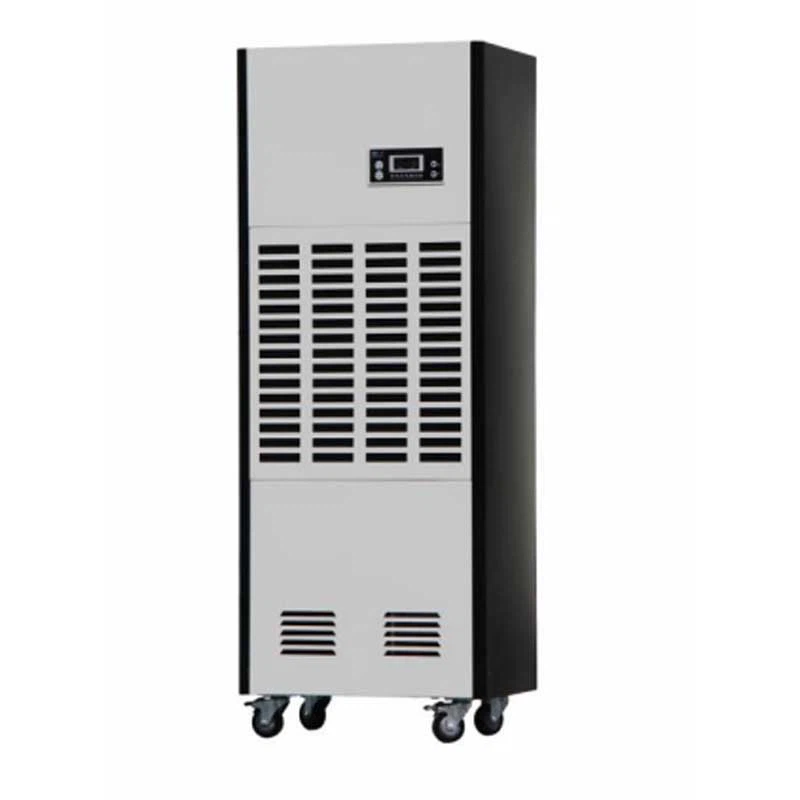
This is one of the most commonly used industrial dehumidification methods. Outdoor air passes through a cooling dehumidification device, where its temperature is lowered below the dew point. Some of the moisture in the air then condenses on the cooling surface and is drained away. The resulting dry air is supplied indoors to absorb moisture, creating a cycle that achieves dehumidification.
Simply put, a fan draws humid air into the machine, where the air passes through a heat exchange system that condenses moisture into water droplets. The dried air is then expelled, reducing relative humidity through continuous air circulation.
This method offers good dehumidification performance, low operating costs, minimal energy consumption, simple operation, easy control, and no requirement for a heat source. However, its effectiveness is influenced by ambient temperature, and the dew point limit for cooling dehumidification is above 0°C. It is suitable for applications with low air volume.
4) Desiccant Dehumidification
Desiccant rotor dehumidification uses a rotor made of solid desiccant material for rotary dehumidification. The core component is a honeycomb rotor composed of a special ceramic fiber carrier combined with a desiccant. The rotor is filled with honeycomb-shaped flow channels. As air passes through these channels, heat and moisture exchange occurs with the channel walls. The walls contain the solid desiccant, which, when cooled by the air, creates a water vapor partial pressure lower than that of the process air. Moisture is then adsorbed into the desiccant. Meanwhile, the sensible heat of the rotor and the adsorption heat released during the process increase the air temperature.
This method easily achieves dry air with low humidity, offers simple operation, and provides stable performance.