1.Overview
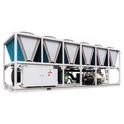
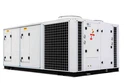
In modern industrial and commercial air conditioning systems, there are various types of air handling equipment, among which the most common ones include air handling units (AHU) and Packaged Desiccant Dehumidifier. The two have certain similarities in appearance and composition - both include modules such as air supply sections, filtration sections, heating/cooling sections, etc., but there are essential differences in core functions and application purposes.
2.Comparison of working principles
|
AHU |
Packaged Desiccant Dehumidifier |
|
|
Core principle |
The comprehensive regulation of air temperature and humidity is achieved through cooling coils, heating coils, humidifiers, fans, etc |
Deep dehumidification is achieved by adsorbing water vapor in the air on the dehumidification rotor through moisture-absorbing materials (such as silica gel, molecular sieves, etc.) |
|
Dehumidification principle |
Dehumidification by freezing (cooling to below the dew point, with condensate water precipitating) |
Dehumidification by adsorption (physical or chemical adsorption of moisture) |
|
Regeneration mode |
No regeneration |
The moisture-absorbing rotor needs to be regenerated by high-temperature hot air (80-140℃) |
|
Medium |
Chilled water/refrigerant/electric heating |
Electric heating/steam/hot water/heat pump regenerative heat source |
3.Functional difference
1) The control ranges for temperature and humidity are different
AHU:
It mainly achieves air temperature regulation and conventional dehumidification.
The dehumidification depth is limited and it can generally reduce the dew point temperature of the air to 10 to 15 degrees Celsius.
It is suitable for comfort air conditioning or ordinary industrial air conditioning environments (such as offices and factories).
Packaged Desiccant Dehumidifier:
It can achieve deep dehumidification, with dew points as low as -20℃ or even lower.
The relative humidity of the air can be controlled to 10% to 40%, meeting the requirements of industries such as precision electronics, lithium batteries, and pharmaceuticals.
The accuracy and stability of humidity control
The AHU mainly relies on cooling and dehumidification, and is restricted by the temperature of the cold water and the heat exchange capacity of the coil, resulting in relatively low humidity control accuracy (±5 to 10% RH).
Packaged Desiccant Dehumidifier, through the absorption of moisture by the rotor and continuous regeneration cycle, has a high humidity control accuracy (up to ±2 to 3% RH), making it suitable for process sites with high requirements for humidity stability.
Air handling methods
AHU: It integrates the regulation of air temperature, humidity and cleanliness, and may include functions such as filtration, heating, cooling and humidification.
Packaged Desiccant Dehumidifier: It mainly deals with humidity and is usually used in combination with cooling coils, reheating sections and other equipment to form a "combined dehumidification air conditioning system".
For instance:
Pre-cooling section → rotor dehumidification section → post-cooling section → Heating section
Such a combination can ensure a low dew point temperature while maintaining a balance between the supply air temperature and energy consumption.
Energy consumption and heat recovery methods
The main energy consumption sources of the AHU are cooling and air supply functions.
In addition to the air supply function, the Packaged Desiccant Dehumidifier also requires regenerative heating energy (such as electric heating, steam, gas, heat pump, etc.).
However, if combined with heat recovery devices (such as heat exchange for regenerative exhaust gas), the operating energy consumption can be significantly reduced.
5) Comparison of application fields
|
AHU |
Packaged Desiccant Dehumidifier |
|
|
Office buildings, shopping malls, hotels |
√ |
X (Unless it is a constant humidity room) |
|
Food and pharmaceutical production workshops |
√(Basic temperature adjustment) |
√(Mold-proof and moisture-proof) |
|
Lithium battery drying room |
X |
√(Typical) |
|
Medical device packaging, electronics factory |
X |
√ |
|
Constant temperature and humidity laboratory |
X |
√ |
|
Ordinary industrial plant |
√ |
X |
4.System configuration differences
Typical sections of AHU
Filtration section → Air mixing section → Cooling coil → Heating coil → Humidification section → Fan section
Typical section of the Packaged Desiccant Dehumidifier
Primary filtration section → Pre-cooling section (refrigeration dehumidification) → adsorption rotor section → recooling section → Heating section → Fan section
(Attached: The regenerative air path includes a heater, a fan and an exhaust port.)
5.Summary
|
AHU |
Packaged Desiccant Dehumidifier |
|
|
Core function |
Temperature adjustment + regular dehumidification |
Deep dehumidification + precise humidity control |
|
Dehumidification principle |
Condensation dehumidification |
Adsorption dehumidify |
|
Humidity precision |
Ordinary(±5~10%) |
high(±2~3%) |
|
Dew point temperature |
≥10℃ |
Lowest -20℃ |
|
Energy consumption mode |
Cooling energy |
Refrigeration + regenerative heat energy |
|
Application |
Comfort air conditioning/ordinary factory buildings |
Places with high humidity/low dew point requirements |
|
System complexity |
Medium |
High (including regeneration loop and heat recovery) |
6.Conclusion
The air handling unit (AHU) emphasizes the comprehensive treatment of air and comfort control, and is an universal air conditioning supply equipment. The Packaged Desiccant Dehumidifier is a dedicated device designed for deep dehumidification and precise humidity control, and is often used in conjunction with the AHU.
In industrial fields with strict humidity requirements (such as lithium batteries, pharmaceuticals, electronics, food drying, military industry, etc.), Packaged Desiccant Dehumidifier are indispensable key equipment. In ordinary factories and public buildings, the AHU is the main force for temperature and humidity regulation.